



Conservation
Neotropical Birding and Conservation actively supports or promotes bird conservation through its Conservation Fund that awards small grants for conservation work or research, carried out by nationals and / or residents of countries in the Neotropics, which may be of conservation benefit to the birds of the region.

166
Awards Granted

14
Countries Covered

$367,000
Value of Awards
Neotropical Birding Conservation Fund
The NBC aims to promote “an interest in Neotropical birds and their conservation”. To help fulfil the conservation objective, we administer a Conservation Awards Programme. Small grants are awarded to Neotropical nationals to support conservation projects directly involving globally threatened bird species or globally important sites within the region. Past beneficiaries have included both professional and amateur ornithologists and ecologists, students, park guards, NGO staff and environmental consultants.
NBC also aims to enhance the appreciation of birds and their conservation among local communities through the programme. To achieve this, projects are judged on their consideration of local engagement and conservation outreach. A key aim is to build local and national capacity for conservation: in many cases awards help the beneficiaries to develop skills and experience towards long-term involvement in conservation. Small grants have been hailed for the big positive impacts they can have for biodiversity and communities.
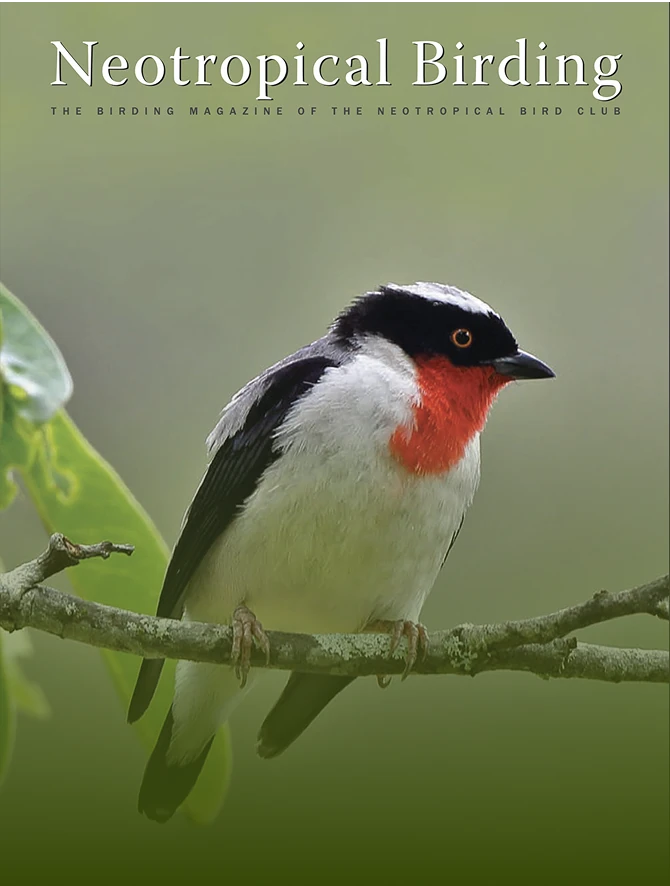
Learn more about the Conservation Fund’s work
Conservation Fund Criteria
In addition to the above requirements of the applicant themselves, NBC advises that, other than in exceptional cases, awards will only be given to projects that meet all of the following criteria:
- Projects with a total budget small enough for the NBC award to be a significant proportion of that total.
- Projects that are likely to achieve constructive local engagement in some form, such as environmental education in local communities, working with local decision-making or land-management organisations, or local/international publicity.
- Projects that are likely to achieve global conservation benefit. This means that the project must target either globally threatened species or globally important sites, as defined below, in order to be eligible for funding, unless there is an exceptional reason to waive this rule (e.g. species new to science). It is essential that your project makes a direct contribution to species or site conservation, or as a minimum is developed in close collaboration with a conservation agency or organisation. We do not fund projects that lack a strong conservation focus, e.g. pure avian biology research. Environmental education projects that encourage the conservation of threatened species or globally important sites are eligible.
- Globally threatened species — those on the IUCN’s global red list — are defined and appear on the website www.birdlife.org/datazone/. We advise that you look at this website when drafting your project proposal. Note that the NBC does not fund work on species that are only threatened at the national level, and, only rarely funds projects on the globally threatened subspecies of birds that are not threatened at the species level.
- Site-based projects must focus on the conservation of either a) an Important Bird Area (IBA), or an area proposed as an IBA or recently found to qualify for designation as an IBA; or b) a site within an Endemic Bird Area (EBA) holding habitats that are important to the restricted-range bird species that define the EBA; or c) a protected or potentially protected area that holds or is expected to hold Threatened or Near Threatened bird species. For information on IBAs and EBAs and how they are designated, see www.birdlife.org/datazone/index.html.
Regarding molecular-based projects, the Council is happy to consider projects which seek to determine whether or not a currently globally threatened species is a valid taxon at the species level, e.g. through DNA analysis. However, these projects must also have a meaningful practical conservation component. Even if the results from the analyses suggest that a taxon that had been considered a Threatened species does not deserve species status, the conservation action aspects of the project still need to be carried out given that they will still be benefiting a Threatened taxon or distinctive population. Only in the instance that a taxon that had been considered a Threatened species and is now regarded as a hybrid should the conservation action aspect of the project be changed – other Threatened species in the area or a more generalised campaign would be appropriate alternative approaches. Moreover, any project that requires the capture of threatened species (for studies that involve invasive sampling) need to justify the techniques used and experience of the participants such that any chance of injury to the target birds (and thus impact on populations) is minimised.
Applicants need to demonstrate that their project is feasible, that they have adequate competence to carry out the project, and that their methodology is suitable. The Club will consider applications that contribute directly to an academic qualification, but account will be taken of any other funding sources available to the applicant. Applicants should review the published literature and refer to relevant texts (particularly those relating to conservation) on their application forms.
We do recommend (although it is optional) that applicants contact the conservation committee before completing the application form. We are happy to discuss project synopses or informal enquiries suggesting a project idea before you submit a formal application. If your project does not meet the criteria listed above, but you feel that it may be an exceptional case (e.g. you plan to study a newly described and probably threatened species), you are strongly recommended to send a summary of your project first. Please note that synopses/informal enquiries must be received at least three weeks before the application deadline to ensure a reply in time for the deadline.
If you have further enquiries please contact the Awards Coordinator at:
Make an Application
Applications must be submitted on the form by email to [email protected]
In completing this form, you will disclose personal data to us (such as, your name and address). Please see our Website Terms & Conditions and Privacy & Cookies Notice for information on how we collect, use, take care of and share, your personal data. Alternatively, you can request a copy by emailing [email protected]